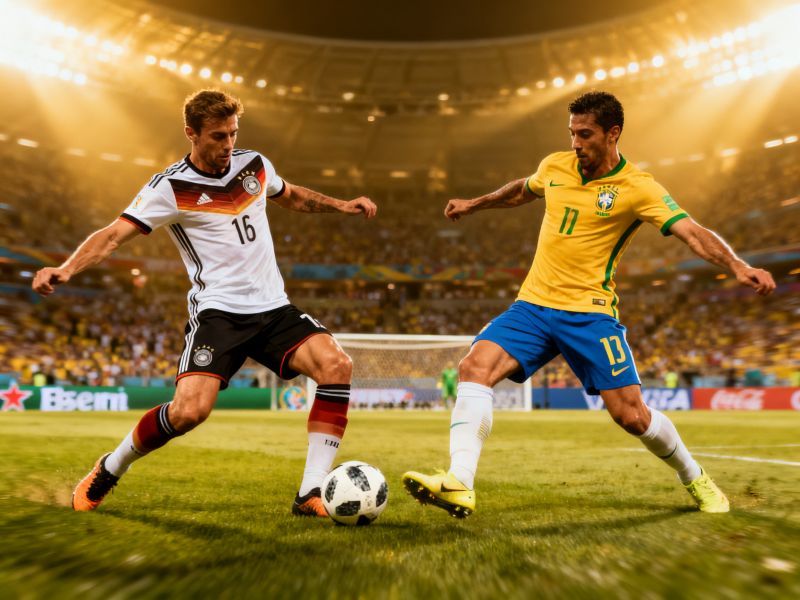
he 7-1 scoreline in Belo Horizonte on July 8, 2014, remains the most surreal 90 minutes in World Cup history. Germany dismantled Brazil with five goals in 18 minutes。and the host nation never recovered. That match didn't just settle a semifinal—it rewired the psychological landscape of the Germany-Brazil World Cup rivalry. Before that night, Brazil held a 2-0 edge in World Cup knockout meetings, including the 2002 final. After it, the fixture carries a different weight: Germany as the clinical executioner, Brazil as the wounded giant.Look back to 2002. Ronaldo's two goals in Yokohama gave Brazil a fifth star, and Oliver Kahn's error on the first goal became a symbol of German vulnerability on the biggest stage. That final was supposed to be the defining chapter. Instead, it became a prelude to the 2014 demolition. The contrast is stark: Brazil's wins over Germany in World Cup play came in 1994 (group stage) and 2002 (final), both by a single goal margin. Germany's 2014 win was a seven-goal anomaly that no tactical analysis fully explains. Thomas Müller's early volley, Miroslav Klose's record-breaking 16th World Cup goal, and André Schürrle's late brace—each moment felt like a separate punch. Brazil's defense。missing Thiago Silva and Neymar, collapsed in a way that exposed systemic fragility, not just bad luck.What makes this Germany-Brazil World Cup dynamic so compelling is the asymmetry of expectation. Brazil has won five World Cups;Germany four. Both have reached the final eight times. Yet Germany has eliminated Brazil in two of their three knockout meetings, and the 2014 result shifted the narrative from 'Brazil's attacking flair vs. Germany's efficiency' to 'Germany's big-game mentality vs. Brazil's emotional fragility.' I remember watching the 2014 match with a group of Brazilian fans in São Paulo—by the 30th minute, the room was silent. One friend kept repeating, 'This isn't real.' That collective disbelief is now part of the rivalry's folklore.Germany's consistency in World Cups is often overstated, though. They crashed out in the group stage in 2018 and 2022, while Brazil has never failed to reach the knockout rounds. The Germany-Brazil World Cup head-to-head record in all competitions is nearly even: Brazil leads 12-11 in total wins。
with five draws. The World Cup stage, however, has favored Germany in recent memory. That tension—Brazil's historical superiority vs. Germany's recent knockout dominance—fuels every preview of a potential meeting. When the draw for 2026 is made, fans will scan for a possible Germany-Brazil collision. It's the fixture that delivers either redemption or repetition.For Brazil, the next Germany-Brazil World Cup match is about exorcising 2014. For Germany, it's about proving that Belo Horizonte wasn't a fluke but a blueprint. Neither side has faced the other in a World Cup since that semifinal. The longer the wait。the more the anticipation builds. Football rarely offers clean narratives, but this rivalry thrives on unresolved history. When they meet again, expect the broadcast to replay that 7-1 scoreline at least a dozen times before kickoff. The players will say it's just another game. Nobody will believe them.